
Geomembrane Welding Construction and Precautions
Geomembrane is a high-performance waterproof and anti-seepage material widely used in landfill, water conservancy engineering, tunnel construction, chemical anti-corrosion and reservoir seepage prevention projects. The welding construction quality directly determines the overall anti-seepage effect and service life of the geomembrane project. Scientific and standardized welding operation and strict implementation of construction precautions are the core guarantees to avoid leakage, damage and aging failures of geomembranes. This paper systematically introduces the standard welding process and key construction precautions of geomembranes.
1. Overview of Geomembrane Welding Process
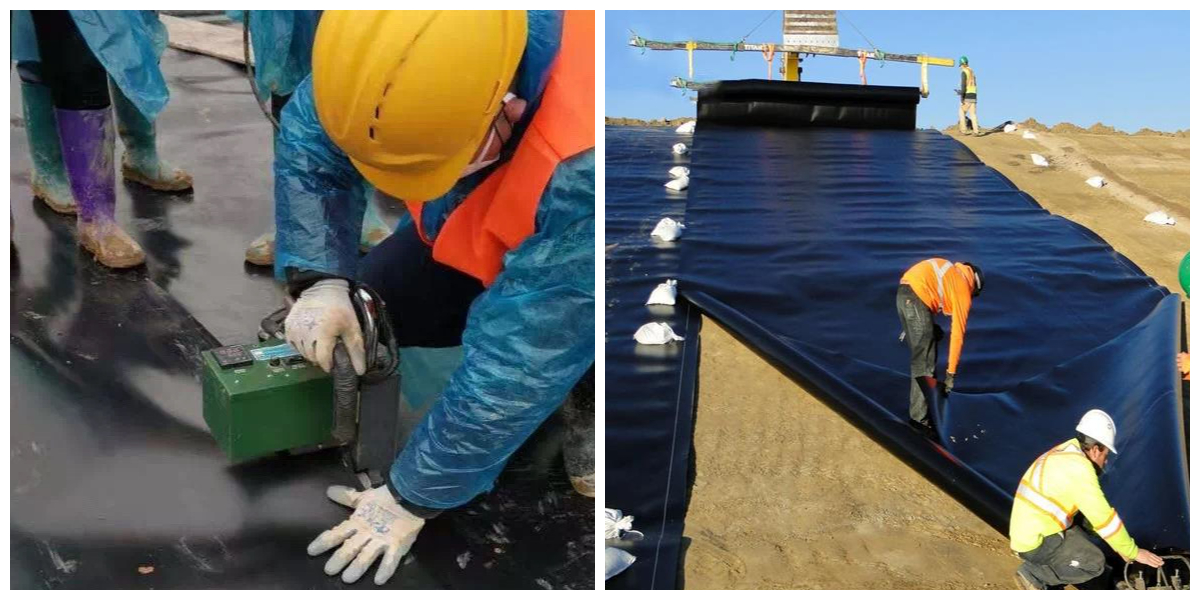
At present, hot wedge welding and extrusion welding are the two mainstream welding methods for geomembranes in engineering construction. Hot wedge welding is mainly used for the lap joint of large-area flat geomembranes, featuring high efficiency, uniform welding quality and stable bonding effect. Extrusion welding is applicable to special parts such as corners, pipe penetrations, wall joints and repair of local welding defects, which can realize targeted reinforcement and seamless connection.
The whole welding construction process follows the sequence of base surface treatment → geomembrane laying and trimming → lap joint adjustment → equipment debugging → formal welding → cooling shaping → quality inspection → defect repair. Each link is interlocked, and any irregular operation will lead to hidden dangers of welding quality.
2. Standard Welding Operation Steps
2.1 Base Surface and Material Preparation
Before welding construction, the construction base surface must be fully cleaned to ensure flatness, dryness and no impurities. Sharp stones, gravel, tree roots, iron nails and other hard protrusions on the base surface shall be removed completely to prevent piercing the geomembrane during welding and laying. Meanwhile, check the quality of the geomembrane raw materials, and reject the materials with cracks, holes, aging, uneven thickness and surface contamination. The geomembrane shall be laid flat and tensioned properly to avoid wrinkles, bulges and excessive stretching, ensuring the lap width meets the design requirements (the conventional lap width is 80-120mm).
2.2 Equipment Debugging
Debug the hot wedge welding machine and extrusion welding machine before construction. Preheat the welding equipment in advance, adjust the welding temperature, walking speed and pressure according to the thickness and material of the geomembrane. For conventional HDPE geomembranes, the welding temperature is generally controlled at 300-400℃, and the walking speed is 2-4m per minute. Conduct trial welding on the leftover materials of the same batch first, and test the tensile strength and sealing performance of the trial welding joint. Formal construction can be carried out only after the test results meet the standard.
2.3 Formal Welding Construction
During hot wedge welding, align the lap joints of the upper and lower geomembranes accurately, keep the lap gap uniform, and place the hot wedge blade between the two layers of membranes. The equipment walks stably and continuously, and the hot melt bonding is realized by thermal compression. The welded joint shall form two uniform and smooth welding strips with consistent width, and no missing welding, virtual welding or offset is allowed.
For special parts that cannot be constructed by hot wedge welding, extrusion welding is adopted. Use the welding machine to extrude the matching geomembrane welding strip, and fill and bond the lap gaps and joint gaps. The welding strip shall be closely combined with the base membrane, with full filling and no gaps, bubbles or cracks.
2.4 Cooling and Shaping
After welding, the geomembrane joint is in a high-temperature hot melt state, and forced stretching, extrusion and folding are prohibited before natural cooling and shaping. The cooling time shall not be less than 5-10 minutes according to the membrane thickness, to ensure the welding joint is fully solidified and the bonding strength reaches the design standard.
3. Key Construction Precautions
3.1 Environmental Condition Precautions
Welding construction shall be carried out under favorable weather conditions. Construction is strictly prohibited in rainy, snowy, foggy and windy days (wind force above grade 5). The surface of the geomembrane must be kept dry during welding; if the membrane surface is wet with dew, rainwater or dust, construction can only be carried out after wiping and drying. The ambient construction temperature is preferably 10-35℃. Too low temperature will cause insufficient hot melt of the geomembrane and poor welding firmness, while too high temperature will easily cause membrane deformation and welding scorching.
3.2 Operation Standard Precautions
Welding operators must receive professional technical training and hold a post certificate, and it is forbidden for untrained personnel to operate the equipment. During the welding process, the walking speed and temperature of the welding machine shall be kept stable, and sudden stop, acceleration or deceleration are prohibited to avoid uneven welding thickness, local overheating and scorching or insufficient melting.
Cross welding and overlapping welding of joints shall be reduced as much as possible. When the joints need to be spliced, the staggered lap method shall be adopted to avoid concentrated stress at the joints. It is forbidden to weld on the geomembrane randomly, and all welding tracks shall be neat and standardized.
3.3 Anti-damage and Protection Precautions
After the geomembrane is laid and welded, construction vehicles, heavy objects and personnel trampling are prohibited on the membrane surface to prevent mechanical damage and crack of welding joints. Subsequent construction operations shall avoid sharp tools touching and scratching the geomembrane and welding joints. If local damage or unqualified welding points are found, they shall be repaired in a timely manner by cutting off the defective part and re-welding, and re-inspection is required after repair.
3.4 Quality Inspection Precautions
All welding joints must undergo comprehensive quality inspection, including appearance inspection and performance testing. For appearance, the welding seam shall be smooth, uniform, free of bubbles, cracks, scorching, missing welding and virtual welding. For performance testing, air pressure detection is adopted for hot wedge welding seams, with the standard air pressure maintained for 3-5 minutes without pressure drop; tensile test is carried out on welding samples, and the fracture position after stretching shall not be at the welding joint.
Hidden welding parts and special node joints shall be inspected one by one without omission, and all unqualified welding positions must be completely rectified before the next process construction.
4. Daily Maintenance and Finishing Precautions
After the completion of welding construction, clean the construction site, cover the welded geomembrane with protective geotextile in time to prevent sunlight long-term exposure and rain erosion, and avoid aging and performance attenuation of the welding joint. For long-term unused welding equipment, clean the residual welding materials on the blade and nozzle, maintain and lubricate the equipment, and store it in a dry and ventilated environment to ensure the stability of subsequent use.
5. Conclusion
Geomembrane welding is a key process related to the overall anti-seepage quality of the project. In actual construction, operators must strictly abide by the standard welding process, strictly control environmental conditions, operation parameters and quality inspection links, and fully implement various construction precautions. Standardized welding operation and perfect quality control can effectively ensure the bonding strength, sealing performance and durability of geomembrane joints, avoid engineering leakage failures, and provide a solid guarantee for the safe and stable operation of anti-seepage engineering.
If you have any geomembrane procurement, construction and technical consultation needs, please feel free to contact me via WhatsApp: +86 15553403434. We can provide professional geomembrane selection, on-site welding guidance and overall anti-seepage engineering solutions to meet different project construction requirements.


