
HDPE Geomembrane Welding for Victoria Regional Landfill, Australia
HDPE Geomembrane Welding for Victoria Regional Landfill, Australia
Project Background
The Victoria Regional Landfill, a key waste management facility serving over 500,000 residents in southeastern Australia, launched an expansion project in 2025 to extend its service life by 15 years. A critical requirement of the project was a high-integrity impermeable liner system to prevent leachate leakage and protect the local groundwater ecosystem. The engineering team selected 2.0 mm thick reinforced HDPE geomembranes, paired with professional hot wedge welding technology, to construct the liner.
Welding Implementation Details
1. Pre-Welding Preparation
Prior to welding, the geomembrane surfaces were thoroughly cleaned to remove dust, debris, and moisture, ensuring no contaminants affected the welding quality. The site temperature was maintained between 15°C and 35°C, as extreme temperatures could cause material brittleness or thermal deformation. The welding team, certified by the International Geosynthetics Society (IGS), conducted a trial weld on sample materials to calibrate parameters: a welding speed of 2.5 m/min, a temperature of 380°C, and a pressure of 0.8 MPa were determined as optimal.
2. On-Site Welding Operation
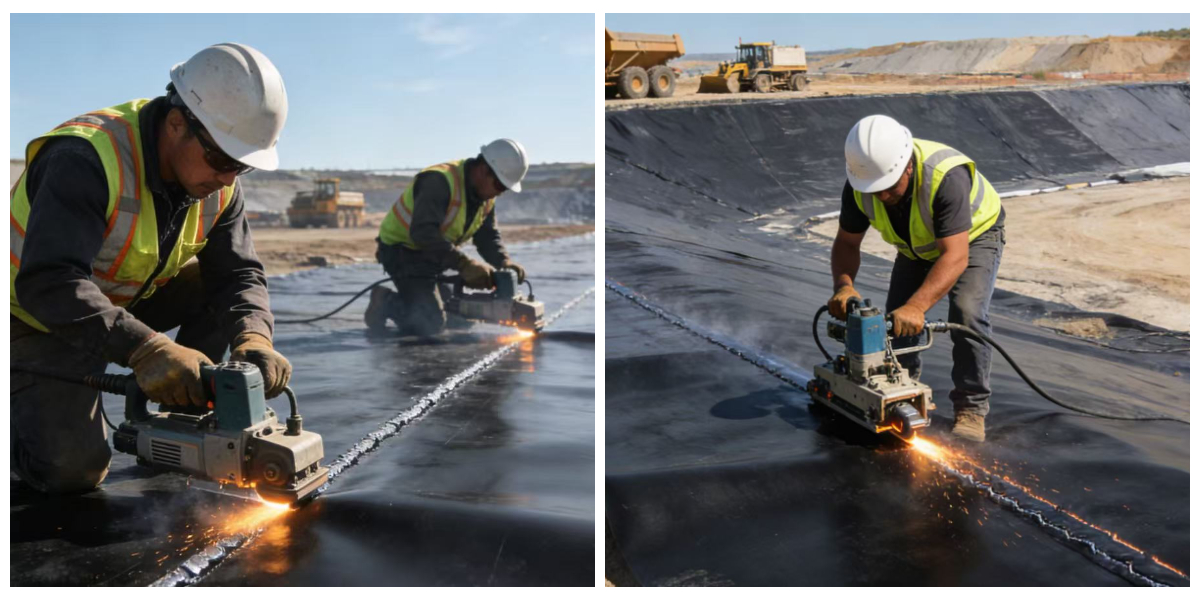
The primary welding method adopted was hot wedge welding, which created two parallel, continuous weld seams for the HDPE geomembrane panels. For corner areas and irregular edges that could not be processed by automatic welding machines, manual extrusion welding was used to ensure full bonding of every joint. The overlap width of geomembrane panels was strictly controlled at 150 mm, and the width of each weld seam was kept at 12–15 mm.
3. Quality Inspection and Testing
Post-welding quality checks were carried out in three stages:
◦ Visual Inspection: All weld seams were examined for defects such as bubbles, gaps, or unevenness; any substandard areas were re-welded immediately.
◦ Vacuum Box Testing: A vacuum box was applied to the weld seams, with a vacuum pressure of 25 kPa maintained for 30 seconds. No air leakage was detected across the 8,500-meter-long weld lines, meeting the Australian AS 4485.3 standard requirements.
◦ Tensile Strength Testing: Random samples of the weld seams were tested, and the average tensile strength reached 92% of the parent material, exceeding the project’s minimum requirement of 85%.
Project Outcomes
The completed geomembrane liner system passed all third-party integrity tests on the first attempt. Since its commissioning in June 2025, the landfill has operated stably, with zero leachate leakage incidents reported. The successful application of professional welding technology not only guaranteed the long-term reliability of the liner but also set a benchmark for geomembrane welding construction in Australia’s waste management sector.
Client Feedback
“The precision and rigor of the geomembrane welding work were crucial to the project’s success,” commented David Carter, the landfill project manager.